Pages

Tuesday, March 4, 2014

I/D #2: Unit O Concept 7-8: Deriving Patterns for Special Right Triangles

Inquiry Activity Summary
The purpose of the activity was to help us apprehend the special right triangle and how its patterns gets what it has. With the special right triangle, it helps us understand where the patterns come from, and instead of memorizing the patterns for both the 45-45-90 degree triangle and 30-60-90 degree triangle, you see how we get each of their side lengths by deriving them.

1. 30-60-90 Triangle


An equilateral triangle makes up of 60 degrees for each of its 3 sides; and making each of its sides equal to one since all its sides and degrees are equal. But when cut in half, its degrees change, and so does its sides. Its degrees become 30-60-90 degrees; the number across 90 degrees stays the same since it side was not cut off, the number across 30 degrees is now “1/2” because 1 was cut in half, so it value was also cut in half, so know the only thing we know need to find is the number that is across 60 degrees.


We use the Pythagorean Theorem to solve for the number side across 60 degrees, which we then get √3/2 as the answer. We then see how each side effects and correlates to the other sides. To get rid of the fractions from each sides, we multiply each side by 2, which gets rid of the fractions; we then get n, n√3, and 2n. After doing that, we multiply each side by “n”. Since “n” is a ratio, it helps the sides get bigger but its value will always stay constant. 

2. 45-45-90 Triangle


When we cut a square that has its four sides equal to 90 degrees and making each of its sides equal to 1 will change when cutting it across diagonally. It cuts the 90 degree angles in half, making it into a 45-45-90 degree triangles. Since two sides of the now triangle stood the same, it is still equal to one, but we now need to find the other side that was cut in half, so we will now use the Pythagorean Theorem to find the hypotenuse, which is the missing side. After finding the hypotenuse side, √2, we put everything together. We then see how each sides correlate and effect each other.


Since there are two 45 degree angles, both of their sides now equal to 1; and the 90 degree angle equals to √2. We then multiply “n” to all three sides and we end up with n, n, and n√2. Since “n” is a ratio, it always stay constant, so even if the numbers you plug in to “n” make the sides bigger, its value will stay constant.

Inquiry Activity Reflection

1. Something I never noticed before about special right triangles is how even though you cut them down, its value will always stay consistent. 

2. Being able to derive these patterns myself aids in my learning because it helps me understand where everything comes from and how one side effects the other sides rather than just itself.

Saturday, February 22, 2014

I/D#1: Unit N Concept 7: The Unit Circle

     The Special Right Triangle (SRT) and the Unit Circle relate to each other in that the SRT helps give you the 30, 45, and 60 degrees points in the UC, which will then help you find the rest of the points in the other three quadrants. But you have to remember the order the points have to be in for each quadrants since they do not go in order.

INQUIRY ACTIVITY SUMMARY
1. 30 Degree Triangle
The first thing I did was plug in the degrees, so I can be able to set it up correctly. I labeled the hypotenuse, vertical value, and horizontal value and it's value for each side so it would be easier for me to know where to put my answers in either "r", "x", and "y". 

Since this is a special right triangle, the hypotenuse or "r", will always be one. In order to turn 2x to 1, you divide 2x to it to get one. Since you did it to "2x", you must also do it to "x radical 3" and "x"; so "x radical 3" turns into "radical 3 over 2" and "x" turns into "1/2". So r=1, x=radical 3 over 2, and y=1/2. After doing all this, you get your 30 degree point, which is (radical 3 over 2, 1/2).

2. 45 Degree Triangle

The first thing I did was plug in the degrees, so I can be able to set it up correctly. I labeled the hypotenuse, vertical value, and horizontal value and it's value for each side so it would be easier for me to know where to put my answers in either "r", "x", and "y". Since this is a SRT, I equaled "r" to 1, and so far, left the rest blank.

In order to get "x radical 2" to equal one, I will have to divide it by "x radical 2". Since I did that to one side, I also do it to the other sides, so both the x's will then equal to "radical 2 over 2". r=1, x=radical 2 over 2, and y=radical 2 over 2. In the end, you get the 45 degree point which is (radical 2 over 2, radical 2 over 2).

3. 60 Degree Triangle

The first thing I did was plug in the degrees, so I can be able to set it up correctly. I labeled the hypotenuse (2x), vertical value (x radical 3), and horizontal value (x); and it's value for each side so it would be easier for me to know where to put my answers in either "r", "x", and "y". Since this is a SRT, the hypotenuse (r) will equal to one.

To be able to get "2x" to equal to one, you divide it by "2x". Since you do it to one side, you do it to the other sides. "x" when divided by "2x" will equal to "1/2". "x radical 3" when divided by "2x" will equal to "radical 3 over 2". So r=1, x=1/2, and y=radical 3 over 2; and the 60 degree point will be (1/2, radical 3/2).

4. This activity helps me derive the Unit Circle in the way that it gives me the points around the Unit Circle and it helps me understand where the numbers come from. It also helps you visualize the SRT in the Unit Circle and how each degree gets its point. You also see the correlation between SRT and UC and how the SRT draws you the details for the UC, but the UC gives you the whole picture and has everything put together.

5. The triangle that was drawn in the activity lies in the first quadrants, since everything is positive, and it is the base of the Unit Circle. To memorize the whole Unit Circle, you just need to memorize the five steps in the first quadrants, which are the 0, 30, 45, 60, 90 degrees, radiants, and points to it. After having those down, you just need to remember some patterns, but you get the concept. The values change when I draw the triangles in Quadrants II, III, and IV, because depending on what the ratios for the trig functions are, you'll know which ones are positive and negatives, but it is still the same.

(http://dj1hlxw0wr920.cloudfront.net/userfiles/wyzfiles/ebaa19ac-ff8b-43a6-a793-a00d9ac15e86.png)

This right here shows Quadrants II, III, and IV, which came from Quadrant I. As you can see, all three are the same in angles, but the only difference is their degree and the quadrants that they are in. All three have the same reference angles and all three share the same points but different connotations, depending if it's positive or negative.

(http://www.regentsprep.org/Regents/math/algtrig/ATT3/reftriex.gif)

This is a 45 degree triangle that is in Quadrant II, which has the same values as Quadrant I, but the only differences is its connotation, since the x-value is negative, while in Quadrant I it is all positive. 

(http://01.edu-cdn.com/files/static/learningexpressllc/9781576855966/The_Unit_Circle_21.gif)

The left picture shows a 60 degree triangle that is in Quadrant III, which also has the same values as Quadrant I, but in this case, because it is in the third quadrant, its x-value and y-value are both negative. On the right picture, it also shows a 60 degree triangle, but is in the fourth quadrant. Like Quadrant II, III, and IV, it has the same values as Quadrant I. In Quadrant IV, the y-value is negative and the x-value is positive.

HEADING FOR THIS SECTION: INQUIRY ACTIVITY REFLECTION
1. The coolest thing I learned from this activity was that everything connects with one another even if it is in different quadrants, its values are the same.
2. This activity will help me in this unit because I am able to memorize the Unit Circle because I am now able to visualize the SRT in the Unit Circle, so I am able to remember the degrees, radiants, and the points, so basically, now I know the whole Unit Circle.
3. Something I never realized before about special right triangles and the unit circle is that if you put them together, you can see the connection between them two and how it works and the details that make the Unit Circle up.

Citations:
(http://dj1hlxw0wr920.cloudfront.net/userfiles/wyzfiles/ebaa19ac-ff8b-43a6-a793-a00d9ac15e86.png)
(http://www.regentsprep.org/Regents/math/algtrig/ATT3/reftriex.gif)
(http://01.edu-cdn.com/files/static/learningexpressllc/9781576855966/The_Unit_Circle_21.gif)

Sunday, February 9, 2014

RWA#1: Unit M: Concept 5: Ellipses

http://www.education.com/study-help/article/pre-calculus-help-conics-ellipses/

1) Ellipse: "The set of all points such that the sum of the distance from two points is a constant." (Taken by Mrs. Kirch's SSS Packet)

2)
 
(http://imanawkwardturtle.files.wordpress.com/2013/03/hyperbolas3.png)
The formula for an Ellipse is (x-h)^2/a^2 + (y-k)^2/b^2 =1 or (x-h)^2/b^2 + (y-k)^2/a^2 =1

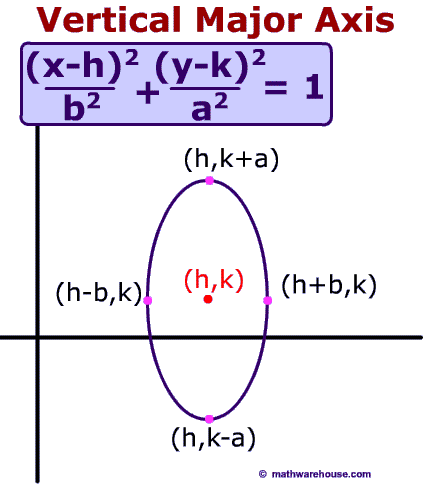
The formula of an ellipse can be determined depending what number is bigger on the denominator. As you see in the image below, if the denominator is bigger under the (x-h)^2, then you will know that your graph will be "fat" or "wide" horizontally. If the denominator is bigger under the (y-k)^2, then you will know that your graph will be "skinny" or "tall" vertically.
(http://www.mathwarehouse.com/ellipse/images/translations/general_formula_major.gif)
As you can see from the picture above, the ellipse is skinny/tall so you will know that it is vertical.

Horizontal Major Axis
(http://image.tutorvista.com/content/feed/u1989/hoe%20ellipse.GIF)
As you can also see from the above picture, the ellipse is fat/short, so you will know that it is horizontal.

    The key features in an ellipse is the standard form, center, skinny or fat, "a=", "b=", "c=", 2 vertices, 2 co-vertices, 2 foci, major axis, minor axis, eccentricity, and the graph.
-To get the standard form of an ellipse you need to complete the square, after you do that, divide everything from the other side to the variables so it can equal to one. After getting your standard form, you look at the denominators of (x-h)^2 and (y-k)^2, and if a^2 is bigger under "x" your graph will be fat, and if the denominator is bigger under "y" then it will be skinny.
-To get your center, you look at (x-h)^2 and (y-k)^2, you equal them to zero, and you get your center. "a=" will always be bigger than "b=", so you look at (x-h)^2 and (y-k)^2, and you square root their denominators; the biggest number is "a=" and the smallest is "b=". To get your "c=", you can use the equation "a^2-b^2=c^2", you plug in the numbers and after you square root the end, you get "c=".
-Your major axis will be the numerator equal to zero, that has the smallest denominator. While the minor axis will be the numerator equal to zero, that has he biggest denominator.
-To get your 2 vertices, you add and subtract the "a=" to the center point of either "x" or "y", depending what the major axis is. To get your 2 co-vertices, you add and subtract the "b=" to the center point of either "x" or "y", depending on what your minor axis is. To get the 2 foci, you put your minor axis and add and subtract to what "c=" and you leave the major axis by itself.
-To get your eccentricity, you use the equation "e=c/a" and you plug in the numbers and you will get your eccentricity, but remember to have it in the thousands place.
-To get your graph, you plug everything that you found, but to remember to use a solid line to show that it is your major axis and to use a dotted line for the minor axis, your foci will always be inside the ellipse, your vertices and co-vertices will be its boundaries, and the shape of your ellipse will match up with either skinny or fat, and your center will be in the middle. The bigger the ellipse, the farther the foci will be, but the closer the ellipse is, the closer the foci is. The foci is the same distance to any point in the ellipse.The foci affects the eccentricity because it determines the shape of the ellipse and how close it is to the ellipse's eccentricity, which equals one. 

3) (https://www.youtube.com/watch?v=lvAYFUIEpFI)
Conics of ellipses can be seen in buildings or statues around the world, but it helps find the height and length of it. The foci that are plugged in can determine what kind of eccentricity you would want as the outcome. Ellipses can be seen in power plants, buildings, statues, basketballs, car logos, and many more things. Just like it says in the video, you can determine your ellipse by putting in what it gives you. You can use what they give you, and you can slowly get the other parts when you connect everything together and do it step by step.


(http://ww1.prweb.com/prfiles/2009/11/19/248313/EllipseofFire.jpg)

-A fun example I will use is the the picture of the eye above. (If you know about the difference about single and double eyelids, then you can comprehend this example easily). Referencing its shape, you can see it as an "single-eyelid eye" or a "double eyelid eye". If the eye has a single-eyelid, you can infer that it is small so its foci would be closer. On the other hand, if the eye has a double-eyelid look, then you can infer that the eye is bigger, so its foci will be farther apart.

4) Work Cited:
  • Mrs. Kirch's Unit M SSS Packet
  • http://ww1.prweb.com/prfiles/2009/11/19/248313/EllipseofFire.jpg
  • https://www.youtube.com/watch?v=lvAYFUIEpFI
  • http://www.education.com/study-help/article/pre-calculus-help-conics-ellipses/ 
  • http://imanawkwardturtle.files.wordpress.com/2013/03/hyperbolas3.png
  • http://www.mathwarehouse.com/ellipse/images/translations/general_formula_major.gif
  • http://image.tutorvista.com/content/feed/u1989/hoe%20ellipse.GIF

Sunday, December 8, 2013

Fibonacci Beauty Ratio

Friends Name: Mia
Foot to Navel: 107 cm
Navel to top of Head: 62 cm
Ratio: 107/62=1.726 cm
Navel to Chin: 43 cm
Chin to top of Head: 21 cm
Ratio: 43/21=2.048 cm
Knee to Navel: 55 cm
Foot to Knee: 49 cm
Ratio: 55/49=1.122 cm
Average: 1.632 cm

Friends Name: Ashley
Foot to Navel: 94 cm
Navel to top of Head: 64 cm
Ratio: 94/64=1.469 cm
Navel to Chin: 43 cm
Chin to top of Head: 22 cm
Ratio: 43/22= 1.956 cm
Knee to Navel: 55 cm
Foot to Knee: 45 cm
Ratio: 55/45=1.222 cm
Average: 1.549 cm

Friends Name: Eriq
Foot to Navel: 111
Navel to top of Head: 62
Ratio: 111/62=1.790 cm
Navel to Chin: 45 cm
Chin to top of Head: 22 cm
Ratio: 45/22= 2.045 cm
Knee to Navel: 62 cm
Foot to Knee: 47 cm
Ratio: 62/47=1.319 cm
Average: 1.718

Friends Name: Tina
Foot to Navel: 93 cm
Navel to top of Head: 58 cm
Ratio: 93/58=1.603 cm
Navel to Chin: 41 cm
Chin to top of Head: 20 cm
Ratio: 41/20=2.050 cm
Knee to Navel: 48 cm
Foot to Knee: 46 cm
Ratio: 48/46=1.043 cm
Average: 1.565 cm

Friends Name: Kelsea
Foot to Navel: 100 cm
Navel to top of Head: 58 cm
Ratio: 100/58=1.724 cm
Navel to Chin: 41 cm
Chin to top of Head: 20 cm
Ratio: 41/20=2.050 cm
Knee to Navel: 53 cm
Foot to Knee: 51 cm
Ratio: 53/51=1.039 cm
Average: 1.604 cm

Based on Fibonacci's Beauty Ratio, both Mia and Kelsea are the most beautiful out of the 5 friends. Both Mia and Kelsea tied for first place by a 0.14 cm difference to Fibonacci's number. Kelsea was 0.14 cm less than 1.618, while Mia was 0.14 cm more than 1.618. The person who was the least beautiful was Eriq, with a 0.1 difference. In fourth place was Ashley, with a 0.069 difference. In third, place was Tina with a 0.053 difference. My opinion on the Beauty Ratio is that it is not accurate, but because I was close to 1.618, it made me happy even though I do not believe it is one-hundred percent true. I believe that the Beauty Ratio is not real because beauty is defined differently for everyone. Beauty in the United States is different than what is beautiful in South Korea. We each have our own standards so I think the beauty ratio is not accurate or true.


SP #6: Unit K Concept 10: Writing a repeating decimal as a rational number using geometric series


The viewers need to make sure to include the summation notation, sum formula, and the sum as their answer. to find "r" you have to get the second number and divide that by the first number to get it. Viewers need to also make sure to add zeroes every time you keep going down. Explanation: Since twelve is made up of two numbers, when you get the other pair you fill their numbers up with zeroes. The viewers also need to make sure to bring down the whole number in the decimal and multiply it with the answer you got or else your answer will be wrong.